
China Top 10 Display Technology Manufacturers for Global Buyers
China has become a major force in the global display technology supply chain. Its manufacturers now serve televisions, smartphones, automotive panels, medical monitors, industrial equipment, and digital signage. However, production scale alone does not guarantee a dependable supplier.
As display technology researcher Professor Shin-Tson Wu has observed, “The best display is not always the brightest; it is the one that serves the application.” This practical view matters for international buyers. A premium OLED panel may suit a flagship smartphone, but it can be excessive for a warehouse terminal. A rugged LCD may perform better in sunlight, temperature changes, and continuous operation.
This guide introduces China’s top 10 display technology manufacturers for global buyers. It considers more than brand visibility. Manufacturing capacity, panel quality, product range, energy efficiency, customization ability, certifications, and export experience also matter. Buyers should examine pixel performance, viewing angles, contrast, touch response, lifespan, and after-sales support. Small details matter. A connector mismatch can delay an entire project.
The list includes established producers and specialized technology companies. Some focus on large OLED panels. Others excel in LCD modules, transparent displays, Mini LED, Micro LED, or industrial solutions. Their strengths are not identical. That is important.
No ranking can fit every purchasing decision. Market data changes. Factory performance may vary by product line. Supplier claims also require verification through samples, audits, and testing. This article therefore offers a practical starting point, not a final verdict. Careful buyers should still question specifications, delivery promises, and long-term support before signing a contract.
Display Technology Manufacturing in China: Scope and Industry Overview
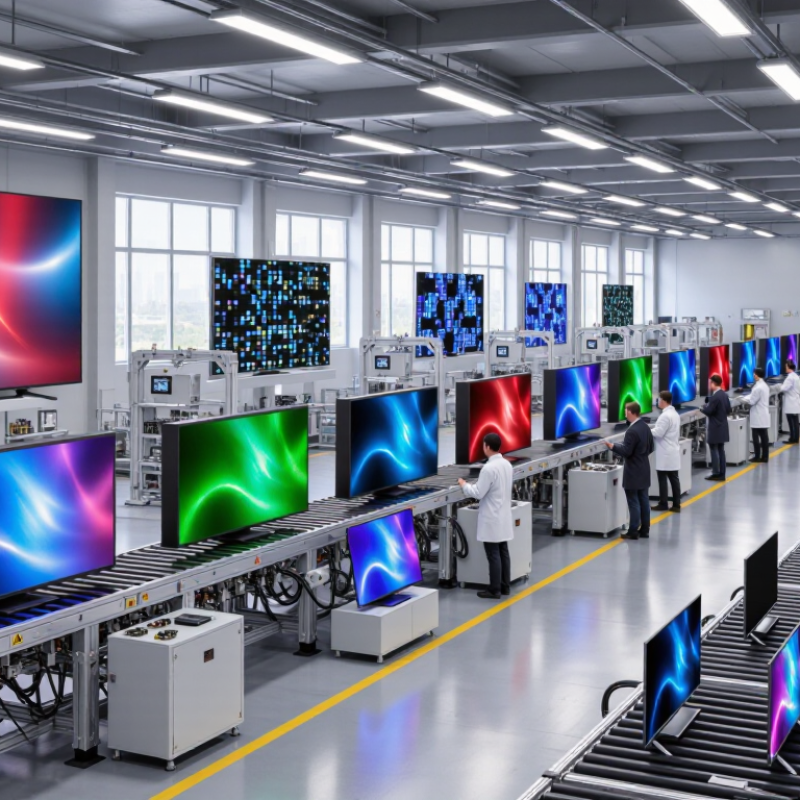
China’s display technology manufacturing sector now covers LCD, AMOLED, mini-LED, display modules, driver circuits, glass processing, equipment, and testing. According to Omdia’s 2024 display supply analysis, China held roughly 70% of global LCD panel capacity in 2023. This scale supports large production runs, shorter component routes, and flexible customization for international buyers.
The supply chain is becoming more advanced. DSCC projects that China could exceed 50% of global AMOLED capacity by 2026. Meanwhile, CINNO Research reported strong year-on-year growth in China’s AMOLED shipment area during 2023, driven by mobile devices, vehicles, and industrial displays. These figures show expanding capability, not automatic superiority. Quality consistency still depends on process control, yield management, calibration, and supplier coordination.
A factory visit can reveal practical details. Engineers may inspect cleanroom conditions, glass handling, bonding accuracy, burn-in testing, and packaging protection. These small steps influence failure rates after shipping. China’s manufacturers also serve televisions, smartphones, vehicle dashboards, medical equipment, retail panels, and smart appliances. Buyers should examine certified testing records, production traceability, sample stability, and backup capacity before placing large orders. Data can look impressive. Factory-level verification remains essential.
China Top 10 Display Technology Manufacturers for Global Buyers - Display Technology Manufacturing in China: Scope and Industry Overview
| Rank | Anonymous Manufacturer Profile | Primary Technology | Typical Product Scope | Common Substrate / Structure | Typical Application Markets | Manufacturing Strength | Buyer Evaluation Focus |
|---|---|---|---|---|---|---|---|
| 01 | Large-area TFT display profile | TFT-LCD | Monitors, televisions, commercial panels and public-information displays | Glass substrate with active-matrix thin-film transistors | Consumer electronics, offices, retail and transportation | High-volume panel production and standardized sizes | Brightness, contrast, viewing angle, uniformity, dead-pixel policy and supply continuity |
| 02 | Active-matrix OLED profile | AMOLED | Smartphone, wearable, automotive and premium portable displays | Organic emissive layers on glass or flexible polymer substrates | Mobile devices, wearables, vehicles and high-end equipment | High contrast, thin construction and flexible-form-factor integration | Burn-in controls, luminance aging, color accuracy, bending radius and lifetime |
| 03 | Flexible display profile | Flexible OLED | Foldable phones, curved instrument panels and wearable modules | Polyimide or other flexible polymer substrate with thin encapsulation | Mobile, automotive, industrial and wearable products | Compact module design and mechanical-flexibility engineering | Crease visibility, repeated-fold performance, encapsulation and module reliability |
| 04 | Small and medium industrial display profile | Industrial TFT-LCD | HMI panels, laboratory equipment, POS terminals and control systems | Glass TFT panel with optional capacitive touch layer | Factory automation, medical equipment, retail and instrumentation | Long-life supply, customized interfaces and industrial temperature options | Operating temperature, availability period, touch compatibility and sunlight readability |
| 05 | Automotive display profile | Automotive-grade TFT-LCD and OLED | Instrument clusters, center information displays and rear-seat systems | Rigid glass or curved display modules with touch integration | Passenger vehicles, commercial vehicles and mobility systems | Wide-temperature design, optical bonding and vehicle-interface customization | AEC-Q-related component controls, vibration, thermal cycling, glare and functional safety processes |
| 06 | Touch-display integration profile | Projected-capacitive touch display | Touch monitors, kiosks, tablets and control panels | TFT display combined with glass or film sensor layers | Retail, education, healthcare, hospitality and industrial control | Customized cover glass, optical bonding and controller integration | Touch sensitivity, glove operation, surface hardness, optical clarity and EMI performance |
| 07 | E-paper and low-power display profile | Electrophoretic display | Electronic shelf labels, readers, logistics tags and signage | Microcapsule-based electrophoretic layer on a panel substrate | Retail, warehousing, publishing and low-power information systems | Very low static power consumption and sunlight-readable reflective images | Refresh speed, temperature behavior, contrast, battery life and wireless integration |
| 08 | LED direct-view display profile | SMD LED and fine-pitch LED | Indoor advertising screens, command centers, stadium displays and digital signage | LED packages mounted on printed circuit board modules | Advertising, events, broadcast, transportation and public spaces | Modular cabinet construction, scalable screen dimensions and high brightness | Pixel pitch, refresh rate, grayscale, cabinet tolerance, heat management and serviceability |
| 09 | Micro-display and optical module profile | Micro-OLED, microdisplay and optical engine | Near-eye displays, viewfinders, industrial optics and smart glasses | Silicon backplane or compact active-matrix display structure | AR/VR, imaging, aerospace, medical and industrial vision | High pixel density, compact packaging and optical-module development | Pixel density, latency, optical efficiency, thermal performance and eye-box characteristics |
| 10 | Custom display module profile | Customized LCD, OLED and touch modules | Embedded displays, smart appliances, meters and specialized equipment | Rigid or flexible panel with customized FPC, bezel, cover lens and interface | Home appliances, medical devices, energy systems and connected hardware | Low-to-medium-volume engineering, rapid customization and module assembly | Drawing control, interface compatibility, tooling ownership, MOQ, lead time and after-sales support |
Related Posts
-
What is a High Brightness Display and How Does it Work?
-
How to Choose the Right Display Module for Your Needs?
-

What is an LCD Display Module and How Does It Work in Electronic Devices
-

What is an LCD Display and How Does It Work?
-
China Best LCD Module Selection Guide for Quality and Performance?
-
Top China Outdoor Display Solutions for Global Buyers?