What Are the Top 10 Types of Outdoor Light Poles?
Choosing the right Light Poles Outdoor system involves more than comparing height, finish, and price. A pole beside a busy road faces different demands from one lining a garden path. Wind pressure, soil stability, corrosion, glare, light distribution, and maintenance access all affect long-term performance. The strongest design usually begins with the site, not the product catalog.
Lighting engineer James R. Benya, PE, FIES, has emphasized a practical principle: “Good lighting is about seeing, not just looking.” That idea guides this review of the top 10 types of outdoor light poles. Streetlight poles can improve roadway visibility. Parking lot poles spread uniform light across asphalt. Bollard poles support safer pedestrian routes. Floodlight poles illuminate wide areas, while decorative poles add character to parks and entrances. Solar poles may reduce trenching, and smart poles can support sensors, controls, and connected infrastructure. High-mast poles serve expansive sites, but they require careful structural planning.
Small details matter.
A poorly aimed fixture can shine into bedroom windows. A weak coating may blister after repeated rain. A pole that looks elegant may still create dark patches beneath its luminaire. These are easy mistakes, and even experienced buyers can overlook them. This guide compares each type through practical criteria, including application, light spread, durability, installation complexity, energy use, and visual comfort. It also considers where each option may fall short, because no outdoor pole performs perfectly in every environment.
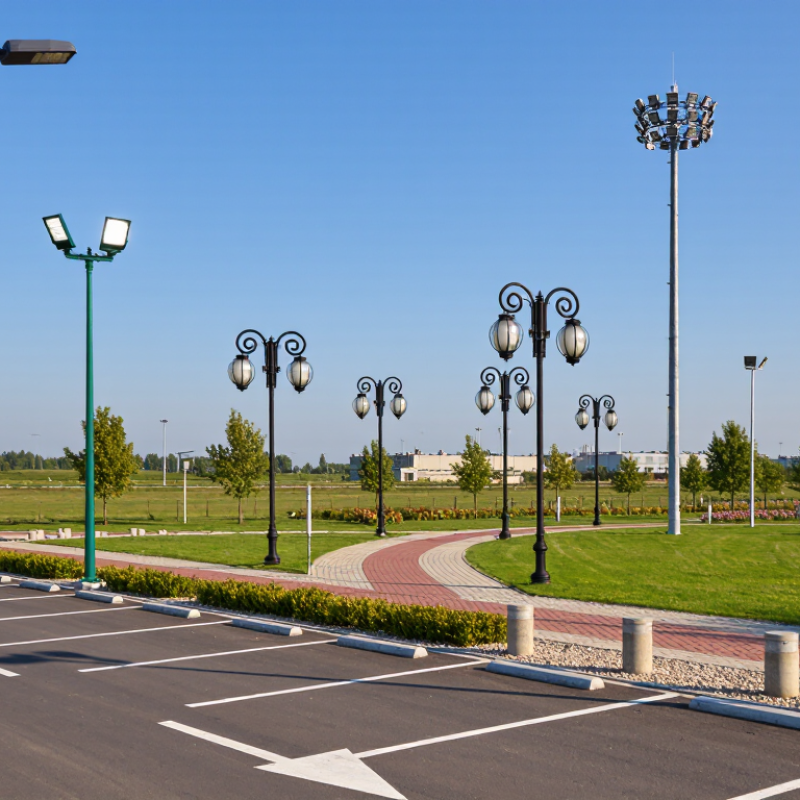
Defining Outdoor Light Poles and Their Main Applications
What Are the Top 10 Types of Outdoor Light Poles?
Outdoor light poles are vertical structures that support luminaires, cables, and sometimes control equipment. Their main purpose is clear: place light safely where people, vehicles, and activities need it. Pole selection also affects illumination quality, maintenance access, wind resistance, and long-term corrosion control.
The ten common types include streetlight poles, parking lot poles, area light poles, high-mast poles, floodlight poles, pedestrian poles, decorative poles, solar light poles, aluminum poles, and galvanized steel poles. Streetlight poles guide traffic along roads, while parking lot poles reduce dark areas near entrances and parked vehicles. High-mast systems cover wide spaces, such as ports or large transport yards. Floodlight poles support powerful fixtures for sports fields and construction areas. Pedestrian poles are shorter and create more comfortable lighting on paths.
Material and shape matter. Steel poles usually provide strong structural performance, while aluminum poles are lighter and resist rust effectively. Concrete poles can suit demanding roadside conditions, although installation may require heavier equipment. Solar poles work well in remote locations, but shading and battery performance need careful checking.
Decorative poles improve public spaces, yet appearance should not replace proper light distribution. In field planning, I have found that foundation depth, local wind data, fixture weight, and maintenance access often receive too little attention. Details matter. A top-ten list is useful, but it cannot replace a site-specific assessment.
Key Factors for Ranking Outdoor Light Pole Types
What Are the Top 10 Types of Outdoor Light Poles?
A useful ranking starts with performance, not appearance. The top ten include cobrahead, shoebox, post-top, decorative, davit-arm, high-mast, floodlight, bollard, solar, and smart modular poles. I rank them by lighting uniformity, wind resistance, corrosion protection, maintenance access, controls, and lifecycle cost. A beautiful pole can still create harsh glare or dark pavement. That matters in parking areas, streets, campuses, and industrial sites.
The U.S. Department of Energy’s 2023 Solid-State Lighting R&D Opportunities report identifies efficacy, controls, and service life as major development priorities. It also records laboratory LED packages above 200 lumens per watt, although complete outdoor systems perform lower. The Federal Highway Administration’s Roadway Lighting Handbook emphasizes uniformity, glare control, visibility, and safe installation. These factors should outweigh a low purchase price. A pole with poor access may cost more over ten years. My ranking is not perfect. Local wind exposure can change everything.
Tips: Check the photometric file before ordering. Review the pole’s EPA rating and wind-load certification. For coastal projects, specify a tested corrosion-resistant finish. Solar poles deserve careful scrutiny, because winter weather and shading can reduce runtime. Smart controls may reduce waste, but only when commissioning and maintenance are planned. Measure the real mounting height, arm reach, and foundation condition. Small errors become expensive.
Ten Common Outdoor Light Pole Types Explained
Ten Common Outdoor Light Pole Types Explained
Outdoor light poles differ by height, shape, mounting method, and site purpose.
A straight steel pole offers a clean profile for streets, parking areas, and walkways. A tapered pole narrows toward the top, reducing visual weight and wind exposure. Fluted poles add vertical grooves for a more decorative appearance.
Davit poles use a curved arm, directing light over roads or broad paths. Bracket-arm poles attach fixtures to a side extension and suit narrow streets.
Mast-arm poles carry luminaires farther from the shaft, helping cover large intersections. Twin-arm poles illuminate both sides of a median or central walkway. High-mast poles rise above expansive spaces, such as ports, sports grounds, and distribution yards.
Decorative poles combine lighting with architectural details and work well near civic buildings.
Solar light poles include panels, batteries, and controls, but their performance depends heavily on sunlight and maintenance. That part is often underestimated.
Tips
Check pole height, foundation depth, wind rating, soil conditions, and fixture weight before selection. Keep light directed downward to reduce glare. Leave service access around electrical compartments.
In my experience, a beautiful pole can still fail the project if maintenance vehicles cannot reach it. Review local engineering requirements with a qualified professional, because site conditions vary.
Comparing Materials, Designs, Heights, and Lighting Uses
What Are the Top 10 Types of Outdoor Light Poles?
Outdoor light poles differ by material, design, height, and lighting purpose. The ten common types include steel, aluminum, fiberglass, concrete, wood, straight, tapered, decorative, bollard, and shepherd’s crook poles. Steel poles suit parking areas because they handle impact and strong fixtures well. Aluminum resists rust and keeps weight low, making it practical near coastal paths. Fiberglass works in wet or electrically sensitive locations. Concrete offers excellent stability, but transportation and installation can be difficult. Wood creates a warm appearance, though it needs regular inspection for moisture and insects.
Design and height should match the site, not personal preference. Straight poles provide clean spacing along roads and large lots. Tapered poles reduce visual bulk and often improve wind performance. Decorative poles fit plazas, gardens, and historic-looking streets. Bollards, usually under five feet, guide pedestrians and illuminate planting beds. Shepherd’s crook poles add gentle downward lighting to walkways. Taller poles, around 20 to 40 feet, cover parking areas with fewer foundations. Shorter poles reduce glare and feel more comfortable near homes.
Light distribution matters as much as height. A wide beam can create bright patches and dark gaps. Poor spacing causes trouble. Check pole loading, soil strength, corrosion exposure, fixture weight, and local electrical requirements before choosing. In practice, the tallest pole is rarely the best answer. I sometimes prefer a lower pole with better optics, although it may require more units and higher installation costs. No material performs perfectly everywhere.
Top 10 Types of Outdoor Light Poles
Representative installation heights compared by pole design, material, and common lighting use.
Heights are typical planning values rather than fixed standards. Short bollard and decorative poles are commonly used for pedestrian areas and landscape lighting, while taller street, parking-area, floodlight, and high-mast poles provide wider roadway, sports-field, industrial, and public-space coverage. Steel and aluminum are widely used for strength and corrosion resistance, while concrete and fiberglass are selected for durability, low maintenance, or specialized environments.
How to Choose the Right Outdoor Light Pole for Each Setting
How to Choose the Right Outdoor Light Pole for Each Setting
Outdoor light poles must match the space, not merely the fixture. A residential street may suit a tapered steel or aluminum pole with a modest decorative profile. Aluminum resists corrosion near coastal air, while steel often handles heavier fixtures economically. For parks, fluted or decorative poles can feel welcoming, but excessive ornament may increase maintenance. Bollard poles work beside paths and gardens. They should provide comfortable guidance without shining into nearby windows.
Large roads often require straight poles with mast arms, while high-mast poles serve wide areas such as interchanges or sports grounds. Davit poles can direct light over lanes, but their curved arms need careful wind review. Concrete poles tolerate impact and harsh weather, although installation equipment can be demanding. Fiberglass poles are lightweight and resist rust. Solar poles suit remote paths, yet winter shade and battery performance need honest assessment. Wood poles blend into rural settings, but moisture damage deserves regular inspection.
Check mounting height, wind load, soil strength, cable access, and the required lighting pattern. Local codes and a qualified structural review remain essential. Field inspections often reveal a simple mistake: the pole is strong, but the foundation is not. I have also seen attractive poles create dark patches because spacing was chosen by appearance. That is not ideal. Review nighttime visibility, glare, corrosion exposure, and maintenance access before approval. A perfect design on paper may still need adjustment outdoors.
